Dec 07, 2025
 3 min read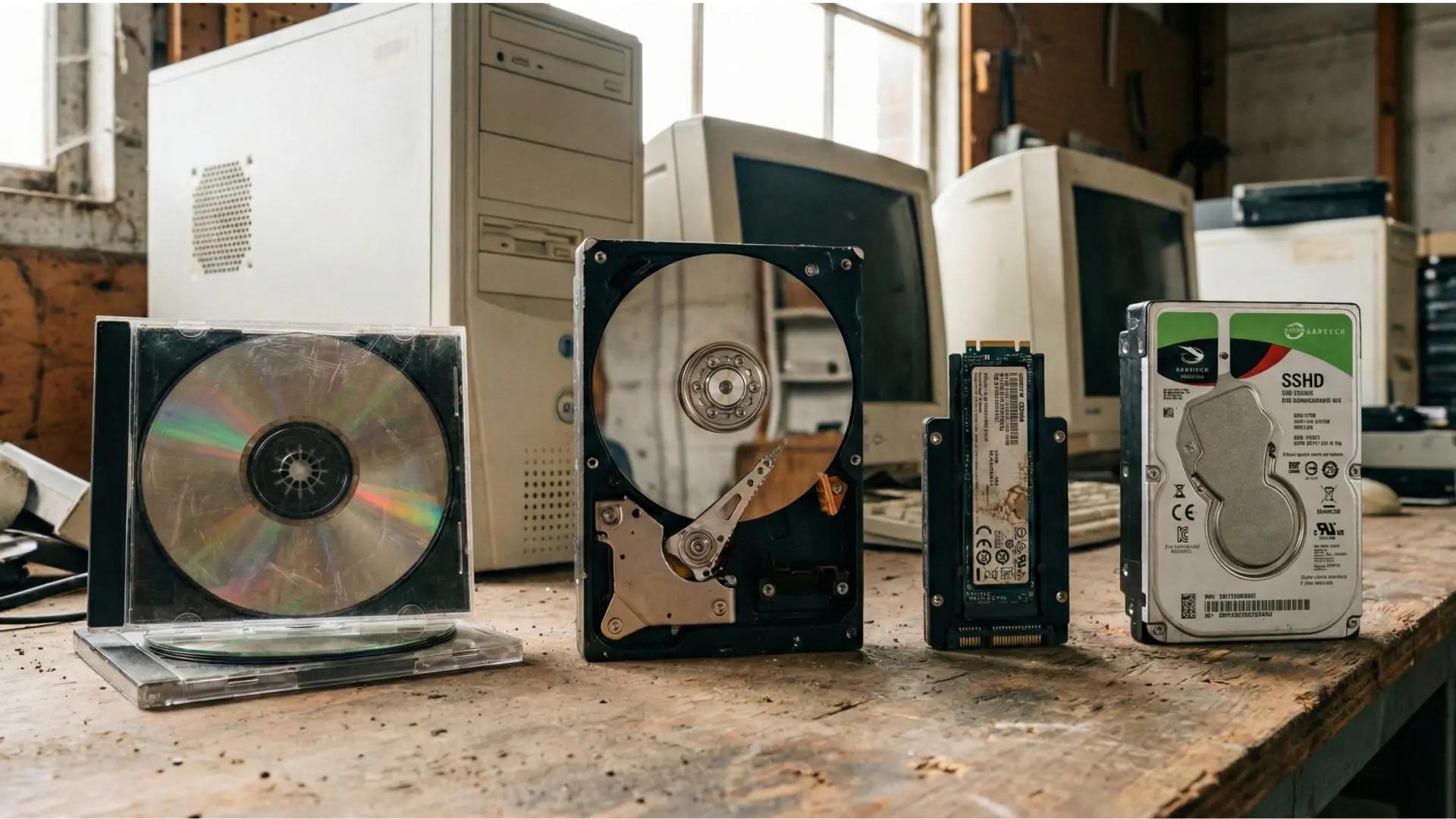
There are storage devices that are not as fast as the CPU or GPU, but this year they lost a lot of importance and many opportunities while still using others.
It's official: Neither USB flash drives nor memory cards, these storage methods are obsolete in 2025.
It is based on facts directly observed and verified by our journalists or knowledgeable sources.
CPUs or GPUs or GPUs cannot end quickly, but this year, but this year they have lost a lot of relevance and opportunities.
For years we lived with non-destructive storage formats, which didn't evolve as fast as CPU or GPU, but still existed and stood the test of time.
However, 2025 confirms a certain turning point, and that is that some methods are still useful, others have become ad-hoc solutions, and many have crossed the line of obsolescence without the option of return.
We're not talking about USB flash drives or microSD cards, which still exist simply for practicality.We're talking about formats that no longer offer any real or technical value, even to undemanding users, they no longer make sense.
The development of NVMe storage, the expansion of streaming, and the rise in prices of SSDs have led to results that seemed impossible a decade ago.What was once the standard is now a relic, and in many cases an obstacle.
CD and DVD
If you grew up in the 90s or early 2000s, CDs and DVDs shaped your relationship with technology.They were the dominant method.music, movies, backup, software distribution, games... everything went via optical disc.
Its capacity marked the limits of what could be stored, and its physical form made it something tangible, simple and immediate.The problem is that its evolution came to an abrupt halt as Blu-ray increased the capacity and left it behind.
Then streaming arrived and eventually buried the format.The small capacity of a CD (700 MB) or a single-layer DVD (4.7 GB) does not compete with anything modern.When high-speed connections became common and external storage became cheaper, these drives lost their raison d'être.
They are the only ones left because of nostalgia and a very special physical distribution.The movie industry still keeps Blu-ray catalogs because of the uncompressed video quality, but CDs and DVDs have become symbolic objects.
Lona Sashu
SSHDs were born as a patch that offered hard disk capacity and a small flash cache to speed up basic tasks.In theory, they combined the best of both worlds.In practice, it was a poor hybrid that never clicked.
When they were launched before 2012, SSDs were still expensive and hard drives were still the highest capacity option for storing large amounts of data.Improvements to HDDS are limited, but Sata SSDs offer a significant leap forward.
As the price of SSDs fell, the SSHD niche evaporated.In 2025, it no longer makes sense to buy one.It doesn't compete on speed, it doesn't compete on efficiency, it doesn't compete on value per euro.It was useful at one time, but because of the pure logic of the market, it disappeared from production.
k SSD m.2
The M.2 form factor completely changed the way storage was built into computers, but the SATA interface, inherited from a much slower era, hindered that design from day one.
For a very short time it is better to make an SSD SSD if you want to eliminate cables and keep the price down;However, this moment has already passed.In 2025, NVMA SSDS will be faster, more efficient and cheaper.
Therefore, installing M.2 SATA today only makes sense if your drive is old and does not support NVme.In any other case, it is a waste of money in a format that becomes the same as a ten-year-old SSD, only in a modern package.
The mechanical hard drive
The hard disk is the veteran of storage, it has been around for decades and has not disappeared, but its role is no longer important.The speed does not bear comparison with a current SSD, even with the most moderate SATA ones.
Load times, noise, heat, wear and tear and vulnerability to shocks had relegated it to a secondary function. Its usefulness now lies in NAS, backups, CCTV and files. Sites where speed is not an important factor.
As a main unit, it no longer makes sense.If you continue to use a hard drive to boot your system, run games, or work with large files, you're missing out on one of the most obvious upgrades a PC can get.
The lifetime of storage technologies is long, but not unlimited.CDs and DVS are seeing a bit of a nostalgia revival.The hard drive stands out thanks to its price per byte.Blu-ray retains its place among teachers.And other formats, such as SSHD or M.2 SATA, have no chance of coming back.
The evolution of cloud, streaming, and NVMe SSDs has redefined how you store your data, consume content, and organize your own system.Better, faster and cheaper options will always prevail.
2025 marks a turning point for several storage formats that seemed set in stone for years.Some no longer make sense, others are relegated to very specific niches, and some are still used by tradition.
Technology always selects what gives real value and discards what no longer offers it.That's why CDS, Shds and M.2 SATA ended up where they are today: in the drawer in the storage room.