Dec 27, 2025
 3 min read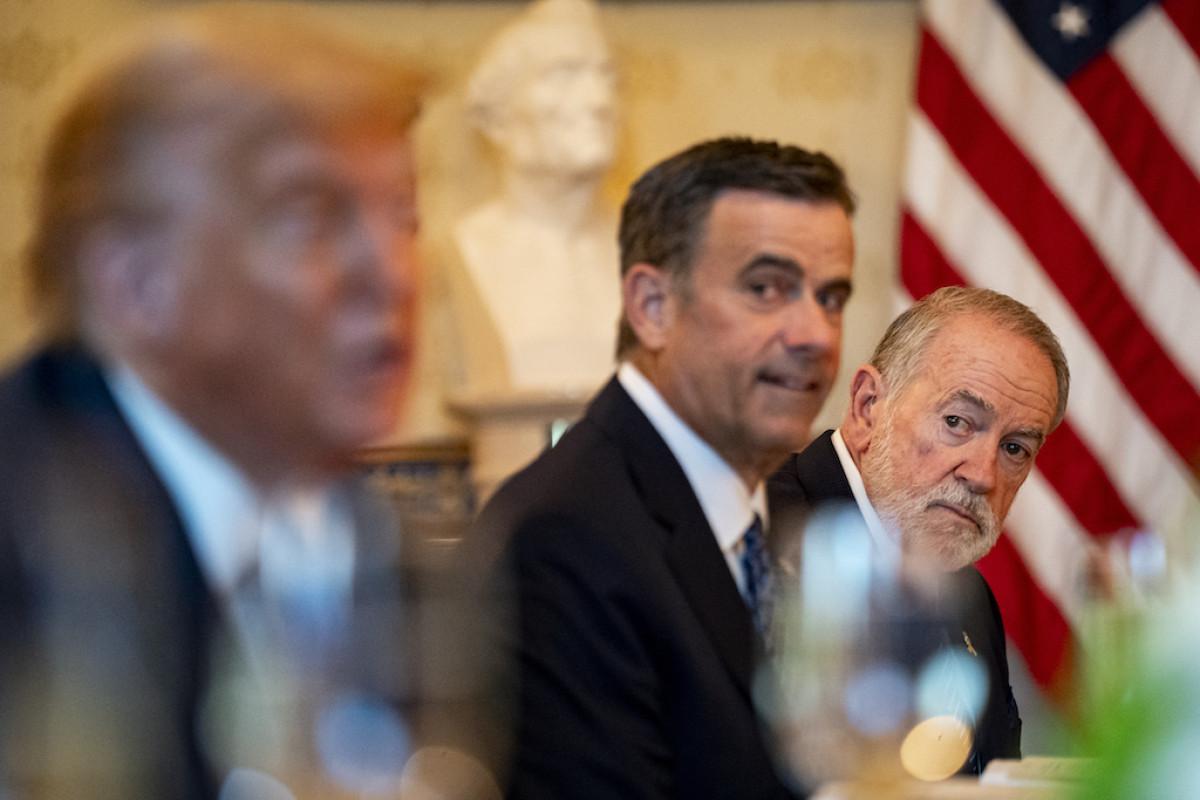
From Washington, D.C., security researcher JP Carroll talks with former CIA officer and geostrategic expert Björn Beam.Advisors from several NATO partner countries confirm that the current situation is suitable for Europe to take its security seriously and discuss the most interesting topics on the agenda, such as Venezuela, the US security strategy or the Gaza conflict.
This ex-CIA agent explains Trump's logic and warns that Europe is "not united".
Washington, D.C.-based security researcher J.P.Carroll speaks with former CIA agent and geostrategic expert Bjorn Beam.The advisor to several NATO partner countries states that the current situation is ideal for “Europe to take its security seriously” and looks at some of the most pressing issues on the agenda, such as Venezuela, the US security strategy or the conflict in Gaza.
US Ambassador to Israel Mike Huckabee (right) and Director of the Central Intelligence Agency (CIA) John Ratcliffe (centre) during dinner with US President Donald Trump.|Al Drago - Poole via CNP/Zuma Press/ContactoPhoto
After the publication of the National Security Strategy of the Trump Administration, Agenda Pública decided to meet with Bjorn Beam, an American geopolitical and technological strategist in Madrid who works for Arcano Partners and has more than ten years in the US intelligence community, including his work as a Central Intelligence Agent member of the daily presidential team (CIA).
It should be noted that Beam is an old friend of the author of this article.Although we do not agree on everything, he is one of the most competent geopolitical analysts and a fundamentally honest person, whose analysis is based on a rare combination of knowledge, optimism and goodwill.
Beam has briefed senior government officials on global threats, emerging technologies and evolving crises, and has led operations to address some of the world's most complex security challenges.He currently advises NATO partners, European institutions and multinational companies on the geopolitical risks and strategic implications of artificial intelligence.
The National Security Strategy of the United States of America
According to Beam, "national security strategy is, in principle, a formalization of priorities. So it takes what politicians see and turns it into the vision they need to implement at the national level, at the economic level, at the intelligence level, [with the full force of the US government].
"The Minangka National Security Strategy formalizes the priorities of the Minangka Doctrine. This is what policymakers want and what approach they want to implement".
The adviser went on to say the document was "very consistent with what (the Trump administration) has been saying all along." He described it as "a formalization of what they call, where we're moving more from coalition politics to power management."
En esencia, este cambio en la política estadounidense, tal y como se describe en la Estrategia de Seguridad Nacional, "no se centra tanto en mantener las alianzas como en administrar la exposición, gestionar el riesgo y cómo Estados Unidos puede posicionarse en una situación de mantenimiento a largo plazo basada en los objetivos y doctrinas de la Administración Trump... Se trata de un cambio clave con respecto a documentos anteriores, que no lo habían expuesto de una manera tan manifiesta".
According to Baym, "This breaks the traditional doctrine of the previous documents [National Security Strategy] and represents a change, especially when we look at our unity in Europe, [a] change from unity to something more changing, to responsibility.
As for China, Beam noted that the document "uses different words to focus on them [China] as an economic competitor, rather than a direct enemy."This is a marked change from previous rhetoric about China during Trump's first term.
"We are seeing a world war on trade routes"
The conversation with the intelligence expert was about the conflict between the United States and Venezuela, and he noted that in Europe, especially in Spain, "there is some surprise, confusion and distrust."He said that if the conflict between the United States and Venezuela escalates, in addition to the attacks on ships that are happening now, it will lead to "increased insurance prices, increased transit costs and increased risk for all types of commercial vessels navigating these [Caribbean] waters."
Beam continued: "We have Chinese [Naval] forces doing something very similar to [Chinese] [U.S. Naval] forces [in the South China Sea], except instead of attacking drug ships, they are positioning themselves around the Philippines, around Vietnam, and of course around Taiwan."
According to the guide, "we are looking at an international consolidation of trade routes that has not been seen in this decade or this century."
About Ukraine, the European Union and European security
"This is an opportunity for Europe to take its security seriously," Beam told Public Agenda.He continued, "He sees a lot of excitement coming from the venture capital space ... (that) this is an opportunity to build local industries."
However, he added, instead of seeing the Europeans, the preference of a UKRIP, and is very small, and has become a lot of interest."
“When you reveal the layers [of the European Union], you quickly get to the nationalist will [of each country].”
"Europe, for various reasons, is neither capable nor ready to be fully productive [in the defense sector]. This is worrying," the expert said.He later added: "We continue to see infighting in the EU, it's not a union. It's not a union."
"When you get a layer of the EU, you quickly get to nationalism (in every country). Regardless of whether it's left-wing or right-wing politics in Europe, there will always be things that go back to national politics," he emphasized.
On the European economy and the impact of American tariffs
A former CIA agent summed up the situation in Europe by saying: "Europe has given its power to Russia, its defense budget to the United States, and its manufacturing capacity to China."
"I think we're starting to see the impact of (U.S.) tariffs, and whether or not U.S. policy changes, we should expect trade costs to increase," Beam told Public Agenda.
"Tariffs prove harmful for US as they bring Europe closer to China"
Beam says, "I hope that the United States are administered because they are approached of China." He promoting questions for European groups?Where are they looking for to build new houses? Where the market they think it's easy to get the hardware of the goods in China and lack of professionals?did it she asked him.
However, she explained, the US triff US triff US in Ukraine to add Europe.The hardest thing is in both sides, "the most progressive progress of e e e'e do you want to do," he said.
"Spain managed to weather the economic and geopolitical storm of the tariffs in the US in a positive way due to a variety of factors," said Bim. He went on to say that the country must "sustain growth in the era of artificial intelligence" and it is necessary to "reexamine business models that see infrastructure security as a key risk and liability that all companies should focus on."
In fact, Beam observed that Spain was protected from the global economic crisis thanks to its membership in the European Union.He also noted that the country itself remains an attractive country for foreign direct investment.
"For many European economies, China's presence offers scale, speed and capital at a time when growing national capacity faces cost and political constraints," he explained to this media.
"At the same time, Beijing approaches Europe with a long-term perspective that combines trade, technology and market presence in a coherent national strategy. The interaction between these two perspectives increasingly defines the relationship," according to Beam.
"With weak domestic demand and China's growth heavily dependent on exports, European markets are realizing potential in the automotive, battery, renewable energy and advanced manufacturing sectors, creating linkages beyond individual transactions," Beam reiterated.
"One of the main obstacles to solving [the conflict] is the lack of agreement on when the conflict actually started," he began.
"Each way out has its own moral logic and suggests a different solution," he said.For Beam, "these competing historical realities shape diplomacy, security planning, and public expectations in ways that resist convergence."
"The United States continues to push for the separation of responsibilities in the post-conflict environment, while Europe emphasizes humanitarian aid and political policy," said Beam, arguing for governance and security gaps that are difficult to close.
If you want to read more Beam reviews, check out their Substack, Beam Intel.
J.P. Carroll
National Security and Inclusive Government is a senior fellow at the Rainey Center for Public Policy
A senior fellow for homeland security and business at the Rennie Center for Public Policy.MBA International Business from IE Business School.Master of Professional Studies (MPS) in Public Relations and Communications from Georgetown University.Former Vice President of Hispanic Media for the Republican National Committee (RNC).JB lives in the Washington, DC area.